
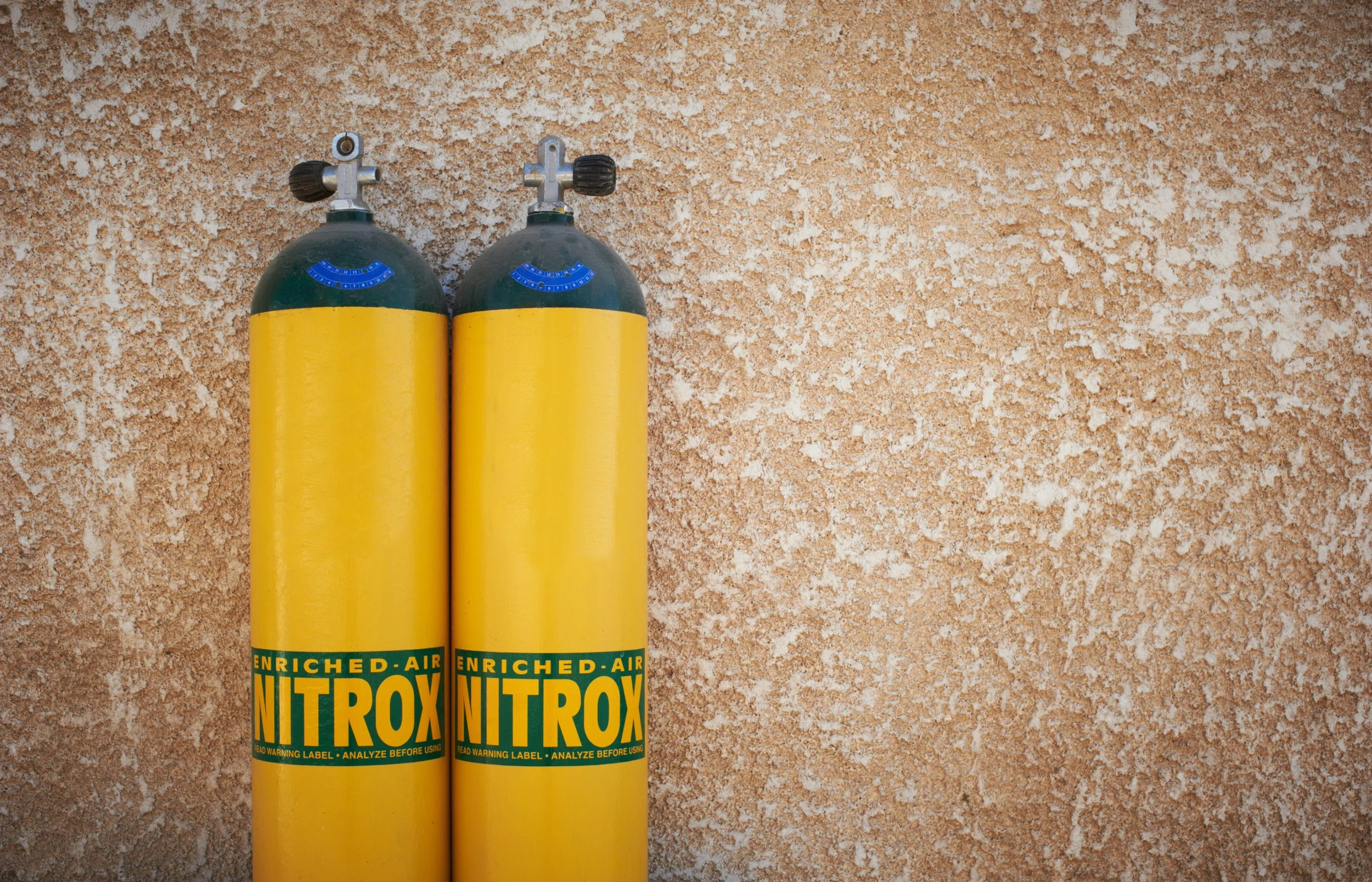
Being Nitrox certified and knowing how to use Nitrox is a must for any diver and everyone should put it at the top of their specialty list. There are some interesting misconceptions about Nitrox that I’d like to discuss. You may have heard some amazing things about Nitrox like, Nitrox can do for you like extend your bottom time, let you go extra deep, and give you energy. Benefits like this make one wonder why we don’t just dive Nitrox from the very beginning, why use regular air at all? Well, there’s nuance here. So, let's talk about what Nitrox does and what it doesn’t.
We’ll start with what it doesn’t do. Nitrox is not a wonder gas. It doesn’t allow you to go especially deep or extend your bottom times. Actually, it reduces your Max Operating Depth (MOD) compared to regular air, and if you don’t have good air management, you’re going to use up your tank at the same rate as any other tank. Now that I’ve popped your nitrox balloon, let’s break it all down.
Here are 5 misconceptions about Nitrox:
Nitrox allows you to dive deeper.
Since Nitrox has a higher percentage of oxygen (typically 32% or 36% compared to 21% in air), it has a shallower Maximum Operating Depth (MOD) than air. The increased oxygen partial pressure at depth leads to an increased risk of Central Nervous System (CNS) oxygen toxicity. For example, EANx32 (Nitrox with 32% oxygen) has an MOD of 34 meters (or 111 feet) at the common limiting 1.4 ATA (atmospheres absolute) partial pressure, whereas air’s MOD is 56 meters (or 187 feet) at the same limit.
Nitrox eliminates the risk of decompression sickness (DCS).
While Nitrox reduces the percentage of nitrogen in the breathing mix, and therefore reduces the nitrogen load absorbed by the body on a dive, it does not eliminate nitrogen entirely. Divers using Nitrox must still follow no-decompression limits and are still susceptible to DCS if they dive aggressively or exceed their limits.
Nitrox is a special gas that requires different equipment: FALSE (Kinda)
For Nitrox mixes with an oxygen content up to 40%, which covers the vast majority of recreational Nitrox diving (most common are EANx32 and EANx36), standard scuba equipment is typically acceptable and safe. However, cylinders, valves, and regulators used for handling mixes greater than 40% oxygen must be “oxygen clean” and use specific O-rings and lubricants to prevent fire risk.
Nitrox gives you unlimited bottom time: FALSE
Nitrox extends your no-decompression limits (NDLs) by reducing nitrogen absorption, giving you longer bottom times than air at the same depth, but your dive time is still fundamentally limited by three factors: the NDLs (even extended), your gas supply, and the risk of oxygen toxicity (the maximum exposure time to oxygen’s partial pressure).
Nitrox can only be used on deep dives: FALSE
People may be confusing Nitrox with Tri-mix, another type of gas mixture that they use in technical dives deeper than recreational dives. In fact, the greatest benefit of Nitrox (extending NDLs) is seen on repetitive, mid-range, and shallow dives (typically 15 to 30 meters or 50 to 100 feet). At these depths, the extended bottom time is most noticeable, allowing divers to spend more time exploring the reef on multi-day dive trips compared to diving with air.
Now let’s tease out the benefits of Nitrox from these misconceptions.
Nitrox extends your NDLs
With your NDLs extended, you can do more repetitive dives with shorter surface intervals. That doesn’t mean you’ll automatically have a tank that lasts longer; you still need to work consistently at improving your air consumption, but as it gets better, your dives can become longer at certain depths than with air. Also, this means you can theoretically do more dives in a day than with air.
You don’t need special gear to dive with Nitrox
You don’t need to make an additional investment in or pay extra to rent a special regulator to use Nitrox. We all know gear is expensive, so something that doesn’t cost extra in diving is always a winner.
Nitrox reduces the chance of decompression sickness (DCS)
Nitrox has a higher oxygen content, which means a lower nitrogen content than regular air. Less nitrogen means less nitrogen for your tissues to absorb during a dive. With your body absorbing less nitrogen, there is less nitrogen for your body to off-gas. Thus, there is less of a chance of getting decompression sickness under the same set of conditions. As mentioned before, the risk is not eliminated; it is reduced.
Nitrox makes you feel less tired after a dive.
Well.. kinda. This is really just a personal thing. No one agrees if this is true, and there isn’t any compelling evidence to support that breathing Nitrox reduces post-dive fatigue compared to air. Fatigue is often related to other factors like cold, exertion, or motion sickness. If you were to go on 5 dives one day on air, then do 5 dives the next day on Nitrox, you might notice a difference. I know dive pros who, if they were going to do over 4 dives in a day, would try to dive 5 and above with Nitrox and insist that it would help with recovery. Again, this is anecdotal evidence. So, if you dive with Nitrox and you think you feel a difference, great! But just don’t be surprised if you don’t feel any difference.
I hope this helped dispel any misconceptions you may have had and expand your understanding of Nitrox. To end, I think knowing how to dive with Nitrox is an essential skill to have as a diver at any level. You don’t have to use it all the time or ever, but knowing what it does, its limitations, and how to use it is important.
If you’re coming on one of our trips, you can easily add the Nitrox certification to your activities, or if you’re in the bay, I can help you get your certification at home.
